What do CONCERT, GIG, SET, SHOW, ACTOR, AGENT, PARTY, PLAYER, GRAND, GREAT, HALF, STEP, FROM NEANDER, HANDY, UPRIGHT, and WISE actually mean? These 16 words span live entertainment, legal terminology, genealogy, paleoanthropology, and everyday English vocabulary. Below, we break down the definition, origin, and real-world usage of each term.
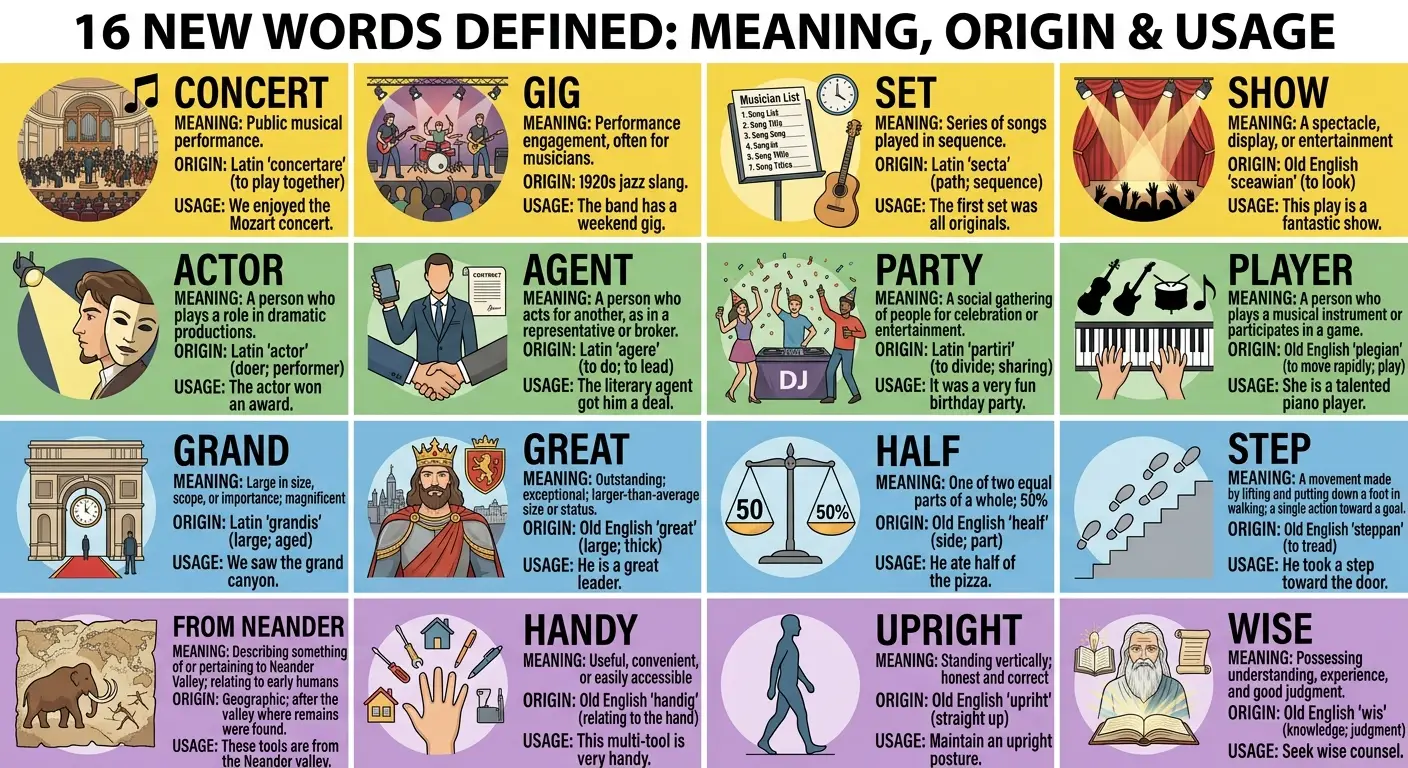
Whether you encountered these words in a word game, a crossword, a quiz, or just daily reading, this vocabulary guide gives you clear, concise explanations with links to authoritative sources. Words are grouped thematically for easier learning.
- Musical Performance: CONCERT, GIG, SET, SHOW
- Participant: ACTOR, AGENT, PARTY, PLAYER
- Family Relationship Modifiers: GRAND, GREAT, HALF, STEP
- Descriptors for Our Human Ancestors: FROM NEANDER, HANDY, UPRIGHT, WISE
CONCERT — Definition and Meaning
Concert is a live musical performance given before an audience, typically by one or more musicians, bands, or orchestras. The word entered English from the Italian concerto, which derives from the Latin concertare — meaning "to contend, debate, or strive together" — reflecting the collaborative interplay among performers. Concerts range enormously in scale: from intimate solo recitals in small venues to massive outdoor festivals drawing hundreds of thousands. Landmark concerts have shaped cultural history — Woodstock (1969), Live Aid (1985), and The Eras Tour have all become defining moments in music history. The phrase "in concert" means performing live, but also figuratively means "working together in agreement" — "The departments acted in concert to solve the crisis." A concert hall is a purpose-built venue designed with optimal acoustics for live musical performance.
GIG — Definition and Meaning
Gig is an informal term for a live musical performance, especially one by a band or small group at a club, bar, or smaller venue: "The band played a gig at the local pub last night." The musical usage emerged in jazz circles in the 1920s, and its exact origin is debated — it may derive from the earlier slang "gig" meaning a job or engagement. Unlike "concert," which often implies a formal, ticketed event, "gig" carries an informal, grassroots energy associated with working musicians playing night after night. The word has since expanded far beyond music: in the modern gig economy, a "gig" is any short-term, freelance, or contract job — driving for Uber, delivering for DoorDash, or freelancing on Fiverr. In computing, "gig" is also informal shorthand for gigabyte.
SET — Definition and Meaning
Set is one of the most polysemous words in the English language, with dozens of distinct meanings across its use as a noun, verb, and adjective. In the context of a musical performance, a set (or "set list") is the specific group of songs a musician or band performs during one continuous appearance on stage: "The DJ played an incredible two-hour set." At festivals, different acts each play their "set" before the next performer takes the stage. Beyond music, a set in tennis is a group of games forming a scoring unit. In mathematics, a set is a well-defined collection of distinct objects — a foundational concept in set theory. In film and theater, the "set" is the physical scenery and structures on stage. As a verb, "set" means to place, establish, or fix — "set the table," "set a record," "set the sun." The word derives from Old English settan.
SHOW — Definition and Meaning
Show is a broad term for a public performance or entertainment event presented before an audience. In music, a "show" is a live performance — often used interchangeably with "concert" or "gig": "Are you going to the show tonight?" The word extends across all performing arts: a Broadway show, a talk show, a game show, a fashion show, or a magic show. As a verb, "show" means to display, demonstrate, or make visible — "Show me the way," "Show your work." The word derives from Old English scēawian ("to look at, see"). Idiomatic expressions abound: "steal the show" (outperform everyone), "run the show" (be in charge), "show must go on" (continue despite difficulties), and "show of hands" (a visual vote). "Showbiz" (show business) encompasses the entire entertainment industry.
ACTOR — Definition and Meaning
An actor is a person who portrays a character in a performance — on stage, in film, on television, or in other media. The word comes from the Latin actor, meaning "a doer" or "one who acts," from agere ("to do, to drive"). Beyond the performing arts, actor has a broader meaning as a participant or agent who takes action in a situation: "The key actors in the negotiation reached an agreement." In international relations, a "state actor" is a government or nation that exerts influence, while a "non-state actor" is an individual or organization operating outside government control. In cybersecurity, a "threat actor" is any entity responsible for a cyberattack. The Academy Awards honor the best actors in cinema annually.
AGENT — Definition and Meaning
An agent is a person who acts on behalf of another, or more broadly, any participant that produces an effect or initiates action. The word comes from the Latin agens, the present participle of agere ("to do, to act"). In business, a legal agent is someone authorized to act for a principal — a real estate agent, a talent agent, an insurance agent. In espionage, a secret agent conducts clandestine operations — immortalized by James Bond, "Agent 007." In science, an agent is any substance or force that produces a specific effect — a "cleaning agent," a "chemical agent," or a "pathogenic agent" (a germ that causes disease). In linguistics, the agent is the entity that performs the action of a verb. In artificial intelligence, an "intelligent agent" is a software entity that autonomously perceives its environment and takes actions.
PARTY — Definition and Meaning
A party is most commonly understood as a social gathering for celebration and entertainment — a birthday party, a dinner party, a house party. But in legal and formal contexts, a party is a participant in an agreement, dispute, or transaction: "Both parties signed the contract," "The injured party filed a lawsuit." The word entered English from Old French partie ("part, side"), from Latin partire ("to divide"). A political party is an organized group sharing a political ideology — the Democratic and Republican parties being the two major U.S. parties. A "third party" is someone outside the primary relationship in a dispute. In gaming, a "party" is a group of characters adventuring together. "Party" also functions as a verb meaning to celebrate: "Let's party!"
PLAYER — Definition and Meaning
A player is someone who participates in a game, sport, or activity — but the word extends far beyond athletics to mean any active participant or influential figure in a situation: "She's a major player in the tech industry." In sports, a player is a member of a team or an individual competitor. In music, a player is someone who plays an instrument — a guitar player, a piano player. In theater, "players" is an archaic term for actors (as in Shakespeare's "the players" in Hamlet). In slang, a "player" describes someone skilled at romantic manipulation — dating multiple people deceptively. In technology, a "player" is a device or software that plays media — a DVD player, a media player. The word derives from Old English plegian ("to exercise, to play"). Common expressions include "team player" (cooperative person), "key player" (important participant), and "player piano" (a self-playing mechanical piano).
GRAND — Definition and Meaning
Grand means large, impressive, or magnificent in size, scale, or ambition — a grand palace, a grand plan, the Grand Canyon. The word entered English from Old French grand, from Latin grandis ("large, great"). In family relationships, grand is a modifier indicating a generation gap of two: your grandmother is your parent's mother, your grandfather is your parent's father, and your grandchild is your child's child. Adding another "great" extends the chain further — a great-grandmother is three generations back. In music, a grand piano is the largest and most prestigious type of piano. In slang, a "grand" means one thousand dollars. A grand jury is a legal body that determines whether there is enough evidence for a criminal trial. A "Grand Slam" in tennis refers to winning all four major tournaments in a single year.
GREAT — Definition and Meaning
Great means of remarkable size, extent, ability, or importance — one of the most common and versatile adjectives in English. It derives from Old English grēat ("big, tall, thick"). In family relationships, great is a modifier that extends the generational chain beyond "grand": a great-grandmother is your grandparent's mother (three generations back), a great-great-grandmother is four generations back, and so on. Each additional "great" adds one more generation. Historical figures bear the epithet — Alexander the Great, Catherine the Great, Alfred the Great. The Great Wall of China, the Great Barrier Reef, and the Great Depression all use "great" to signal extraordinary magnitude. "Great" has also become one of the most common casual affirmatives: "That's great!"
HALF — Definition and Meaning
Half means one of two equal parts of a whole — 50 percent, or the fraction ½. The word derives from Old English healf, from Proto-Germanic *halbaz. In family relationships, half is a modifier indicating that two relatives share one biological parent rather than two: a half-brother or half-sister shares either the same mother or the same father, but not both. This distinguishes them from "full" siblings (who share both parents) and "step" siblings (who share no biological parents). Beyond kinship, "half" appears in countless compounds: halftime (the middle break in a sporting event), half-hearted (lacking enthusiasm), halfway (the midpoint), half-life (the time for half a radioactive substance to decay), and half-mast (the position of a flag lowered in mourning). "Better half" is an affectionate term for one's spouse.
STEP — Definition and Meaning
A step is the act of lifting and placing one foot in front of the other while walking — the most fundamental unit of human locomotion. The word comes from Old English stæpe or stepe. Figuratively, a "step" is a single action in a process or sequence: "Step one: gather your materials." In family relationships, step is a modifier indicating a relationship created by marriage rather than biology: a stepmother is the woman married to your biological father, a stepfather is the man married to your biological mother, and stepsiblings are the children of your parent's new spouse. The prefix derives from Old English stēop-, meaning "orphaned" or "bereaved" — originally reflecting the loss of a parent, not the gaining of a new one. The cultural image of the "wicked stepmother" pervades fairy tales from Cinderella to Snow White. Other uses include staircases (steps), dance steps, and "twelve-step program."
FROM NEANDER — Definition and Meaning
The phrase from Neander refers to the Neanderthal (Homo neanderthalensis), an extinct species of archaic human that lived in Europe and western Asia from approximately 400,000 to 40,000 years ago. The name literally means "from the Neander Valley" (Neanderthal in German, where Thal means "valley") — the limestone gorge near Düsseldorf, Germany, where the first recognized Neanderthal fossils were discovered in 1856. The valley itself was named after 17th-century theologian Joachim Neander. Neanderthals were stocky, powerfully built human ancestors with large brains — in fact slightly larger on average than modern humans. They made sophisticated stone tools, buried their dead, used pigments, and may have spoken language. Modern humans of European and Asian descent carry approximately 1–4% Neanderthal DNA, evidence of interbreeding between the two species tens of thousands of years ago.
HANDY — Definition and Meaning
Handy means useful, convenient, or skillful with one's hands — "This tool is really handy," "She's handy with a wrench." The word derives from "hand" plus the suffix "-y." In paleoanthropology, handy is the English translation of habilis in Homo habilis — literally "handy man" or "skillful man." Homo habilis is one of the earliest known species of the genus Homo, our human ancestors, living approximately 2.1 to 1.5 million years ago in East and South Africa. The name was chosen by Louis Leakey, Phillip Tobias, and John Napier in 1964 because this species was associated with the earliest known Oldowan stone tools found at Olduvai Gorge, Tanzania — marking the dawn of tool use in the human lineage. A "handyman" is a person skilled at home repairs.
UPRIGHT — Definition and Meaning
Upright means vertical, erect, or in a straight-up position — "Stand the book upright on the shelf." Figuratively, "upright" describes a person of strong moral character: honest, principled, and honorable — "an upright citizen." In paleoanthropology, upright is the English translation of erectus in Homo erectus — literally "upright man." Homo erectus was a remarkably successful species of human ancestor, living from approximately 2 million to 110,000 years ago. Named by Dutch anatomist Eugène Dubois in 1893 after discovering fossils in Java, Indonesia, Homo erectus was the first human species to walk with a fully modern bipedal gait, the first to leave Africa, the first to use fire systematically, and possibly the first to cook food. An "upright piano" is a compact piano with vertical strings, as opposed to a grand piano.
WISE — Definition and Meaning
Wise means having or showing good judgment, deep understanding, and the ability to apply knowledge and experience thoughtfully — "a wise decision," "a wise old teacher." The word derives from Old English wīs, from Proto-Germanic *wīsaz, related to the word "wit." In paleoanthropology, wise is the English translation of sapiens in Homo sapiens — literally "wise man" or "knowing man." Homo sapiens is our own species — modern humans — the only surviving species of the genus Homo and the last remaining human ancestors' lineage. The species name was assigned by Carl Linnaeus in 1758 in his Systema Naturae. Modern Homo sapiens emerged in Africa approximately 300,000 years ago and eventually spread across every continent. The full taxonomic designation Homo sapiens sapiens ("wise wise man") distinguishes anatomically modern humans from archaic subspecies. Wisdom traditions pervade every culture, from King Solomon to Confucius to the Seven Sages of Greece.
Summary of All 16 Word Definitions
Here's a quick-reference table for all 16 words covered in this vocabulary guide:
| Word | Short Definition | Category |
|---|---|---|
| CONCERT | A live musical performance before an audience | Music |
| GIG | Informal term for a live musical performance or job | Music / Slang |
| SET | A group of songs performed in one appearance; also a collection | Music / Noun |
| SHOW | A public performance or entertainment event | Entertainment |
| ACTOR | A performer in drama; also a participant in an event | Theater / General |
| AGENT | One who acts on behalf of another; a participant | Law / General |
| PARTY | A social gathering; a participant in legal matters | Social / Legal |
| PLAYER | A sports competitor; any active participant | Sports / General |
| GRAND | Large and impressive; family prefix skipping a generation | Adjective / Kinship |
| GREAT | Of remarkable size or importance; extends family generations | Adjective / Kinship |
| HALF | One of two equal parts; sharing one biological parent | Fraction / Kinship |
| STEP | A footstep; family relation created by marriage | Noun / Kinship |
| FROM NEANDER | Refers to Neanderthal — "from the Neander Valley" | Paleoanthropology |
| HANDY | Useful or skillful; translates habilis in Homo habilis | Adjective / Paleoanthropology |
| UPRIGHT | Vertical or morally honest; translates erectus in Homo erectus | Adjective / Paleoanthropology |
| WISE | Having good judgment; translates sapiens in Homo sapiens | Adjective / Paleoanthropology |
Frequently Asked Questions
What is the difference between a concert and a gig?
A concert typically refers to a formal, ticketed live musical performance, often in a large venue. A gig is more informal, usually describing a smaller or more casual performance at a club or bar.
What does set mean in music?
In music, a set is the group of songs a performer plays during one continuous appearance on stage. At festivals, each artist performs their own set before the next act takes over.
What does actor mean outside of theater?
Beyond performing arts, an actor is any participant who takes action in a situation — such as a "state actor" in international relations or a "threat actor" in cybersecurity.
What does party mean in legal terms?
In law, a party is any person or entity involved in a legal agreement, transaction, or dispute — for example, "Both parties agreed to the settlement terms."
What is a half-sibling?
A half-sibling is a brother or sister who shares one biological parent with you but not both — as distinguished from a full sibling (both parents shared) or a step-sibling (no biological parents shared).
What does step mean in family relationships?
In family relationships, "step" indicates a bond created by marriage rather than biology — a stepmother is the woman who married your biological father, and step-siblings are children of your parent's new spouse.
Who were the Neanderthals?
Neanderthals were an extinct species of archaic humans who lived in Europe and western Asia from about 400,000 to 40,000 years ago. Their name means "from the Neander Valley" in Germany, where their fossils were first identified.
What does Homo habilis mean?
Homo habilis means "handy man" or "skillful man" in Latin. They were among the earliest members of the genus Homo, named for their association with the first known stone tools at Olduvai Gorge, Tanzania.
What does Homo sapiens mean?
Homo sapiens means "wise man" in Latin. It is the scientific name for our own species — modern humans — assigned by Carl Linnaeus in 1758.