What do BEAT, FRIED, SPENT, WORN OUT, LEG, PHASE, STAGE, STRETCH, CHAMOMILE, GRINCH, HOTFOOT, LANYARD, BEANSTALK, EYESHADOW, HIGHTAIL, and SOUNDTRACK actually mean? These 16 words span informal slang, project management, botany, literature, cosmetics, linguistics, and everyday English vocabulary. Below, we break down the definition, origin, and real-world usage of each term.
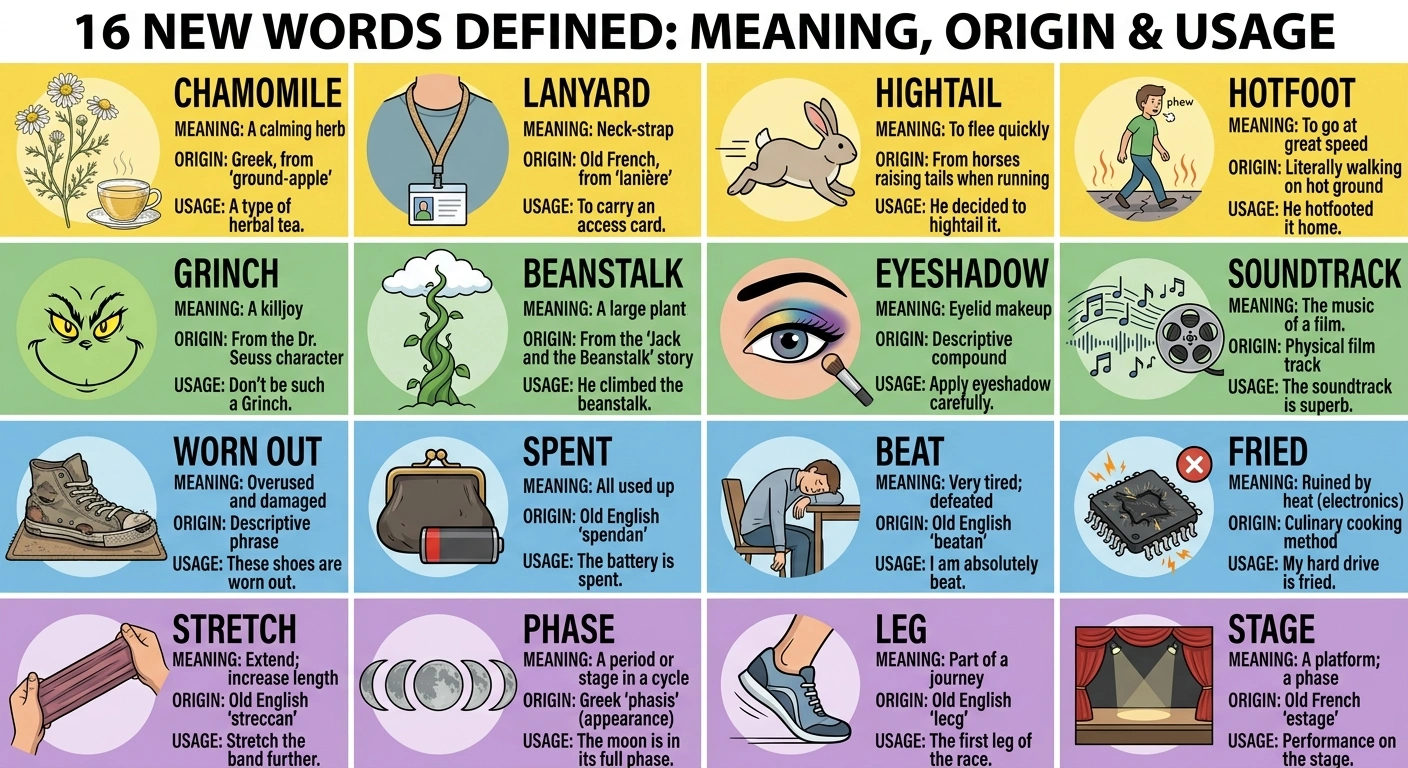
Whether you encountered these words in a word game, a crossword, a quiz, or just daily reading, this vocabulary guide gives you clear, concise explanations with links to authoritative sources. Words are grouped thematically for easier learning.
- Exhausted Synonyms: BEAT, FRIED, SPENT, WORN OUT
- Segment Synonyms: LEG, PHASE, STAGE, STRETCH
- Ending in Units of Length: CHAMOMILE, GRINCH, HOTFOOT, LANYARD
- Ending in Synonyms for "Follow Secretly": BEANSTALK, EYESHADOW, HIGHTAIL, SOUNDTRACK
BEAT — Definition and Meaning
Beat is one of the most versatile words in English, with over a dozen distinct meanings. As a verb, it most commonly means to strike repeatedly ("beat a drum"), to defeat ("beat the competition"), or to stir vigorously ("beat the eggs"). As an adjective in informal speech, beat means completely exhausted — physically drained and utterly tired: "I'm beat after that 12-hour shift." This slang usage emerged in mid-20th-century American English. The word also connects to the Beat Generation, the influential 1950s literary movement led by Jack Kerouac, Allen Ginsberg, and William S. Burroughs — where "beat" carried connotations of weariness, spiritual exhaustion, and beatitude. In music, a beat is the basic unit of rhythm, the pulse that drives a song. A police officer's "beat" is their assigned patrol area.
FRIED — Definition and Meaning
Fried is the past tense of "fry," meaning to cook food in hot oil or fat — producing beloved dishes from French fries to fried chicken to tempura. In informal American English, fried means completely exhausted, mentally drained, or burnt out: "My brain is fried after that exam." The metaphor vividly evokes the image of something that has been subjected to intense, sustained heat until it's crispy and spent. The slang extends further: electronics that have short-circuited are "fried," and someone who has overindulged in substances may be described as "fried." The word derives from the Old French frire, from Latin frīgere ("to roast or fry"). Frying is one of humanity's oldest cooking techniques, dating back thousands of years to ancient Egypt.
SPENT — Definition and Meaning
Spent is the past tense and past participle of "spend," meaning to use up money, time, energy, or resources. As an adjective, spent means completely exhausted — having no energy, force, or usefulness remaining: "The runners were spent after the marathon." The word derives from the Old English spendan, borrowed from Latin expendere ("to weigh out, pay"). The metaphor is powerful: just as money that has been spent is gone, a person who is "spent" has expended all their physical or emotional reserves. The term extends into specific domains: a "spent cartridge" is a bullet casing that has been fired and is now empty; "spent fuel" in nuclear energy refers to used fuel rods that can no longer sustain a chain reaction; a "spent force" describes a movement or influence that has lost its power and relevance.
WORN OUT — Definition and Meaning
Worn out (also written as "worn-out") means damaged, deteriorated, or rendered useless through prolonged use — or, when describing a person, completely exhausted and depleted of energy: "I'm completely worn out from moving furniture all day." The phrase combines "worn" (past participle of "wear") with "out" (indicating completion or depletion). Applied to objects, worn out describes things that have deteriorated beyond useful service — worn-out shoes, worn-out tires, a worn-out sofa. Applied to people, it conveys total physical and mental fatigue, a state of being used up by sustained effort. The related concept of wear and tear describes the gradual degradation of materials through normal use — a principle central to engineering, insurance, and everyday life. "Wearing out your welcome" means staying somewhere too long.
LEG — Definition and Meaning
Leg primarily refers to the limb used for standing and walking in humans and animals — extending from the hip to the foot. But beyond anatomy, "leg" has a widely used figurative meaning: a segment or stage of a journey, race, relay, or process. A "leg" of a trip is one distinct portion: "The first leg of the flight goes to Chicago, then we connect to London." In relay races, each runner completes one "leg." In cricket, the "leg side" is the half of the field behind the batsman. In finance, a "leg" is one component of a multi-part trade strategy. The word entered English from Old Norse leggr. Common idioms include "break a leg" (good luck, especially in theater), "leg up" (an advantage), "doesn't have a leg to stand on" (lacks a valid argument), and "pulling someone's leg" (joking or teasing).
PHASE — Definition and Meaning
Phase means a distinct segment, period, or stage in a process of change or development. The word comes from the Greek phasis, meaning "appearance" — originally used to describe the changing appearances (phases) of the Moon as it orbits Earth. In everyday usage, phases describe periods in a person's life or a project's development: "It's just a phase," "Phase 1 of the construction project." In physics, a phase of matter is a distinct form — solid, liquid, gas, or plasma — and a phase transition is the transformation from one state to another (like ice melting to water). In electrical engineering, phase describes the timing relationship between alternating current waveforms — hence "three-phase power." As a verb, "phase in" means to introduce gradually, and "phase out" means to discontinue gradually.
STAGE — Definition and Meaning
Stage is a richly polysemous word with interconnected meanings. As a segment or phase, a stage is a distinct step in a process, development, or journey: "the early stages of cancer," "a stage of grief," "the final stage of the race." In theater, a stage is the raised platform where performers act — giving rise to expressions like "set the stage" (prepare conditions), "stage fright" (performance anxiety), and "center stage" (the focus of attention). A stagecoach was a horse-drawn vehicle that traveled in stages (segments) between relay stations. In rocketry, a stage is a section of a rocket that fires and then separates — the Saturn V that carried Apollo astronauts had three stages. The word derives from Old French estage, from Latin stāticum ("standing place").
STRETCH — Definition and Meaning
Stretch means to extend, lengthen, or spread out to full length. As a noun denoting a segment, a stretch is a continuous extent of time, distance, or space: "a long stretch of highway," "a stretch of good weather," "the home stretch." The "home stretch" (or "homestretch") — originally the final straight portion of a racetrack before the finish line — has become a universal metaphor for the last phase of any endeavor. In exercise, stretching is the practice of elongating muscles to improve flexibility and prevent injury. In baseball, the "seventh-inning stretch" is a beloved tradition where fans stand and stretch during the middle of the seventh inning. The word derives from Old English streccan ("to extend"). "By any stretch of the imagination" means even with the most generous interpretation.
CHAMOMILE — Definition and Meaning
Chamomile (also spelled camomile) is an aromatic herb of the daisy family (Asteraceae) known for its small, white-petaled flowers with yellow centers and its apple-like fragrance. The name comes from the Greek khamaimēlon, meaning "earth apple" (khamai = "on the ground" + mēlon = "apple"). The two most common species are German chamomile (Matricaria chamomilla) and Roman chamomile (Chamaemelum nobile). Chamomile tea — made by steeping dried chamomile flowers in hot water — is one of the world's most popular herbal teas, traditionally consumed as a calming bedtime drink and folk remedy for insomnia, anxiety, and digestive ailments. In the context of wordplay, CHAMOMILE ends in the unit of length mile.
GRINCH — Definition and Meaning
A Grinch is a person who spoils the enjoyment of others — a killjoy, a spoilsport, or a joyless curmudgeon, especially during the holiday season. The word comes from Dr. Seuss's beloved 1957 children's book How the Grinch Stole Christmas!, in which the Grinch is a bitter, cave-dwelling creature who despises Christmas and hatches a scheme to steal all the holiday decorations, presents, and food from the cheerful residents of Whoville. The Grinch's heart is described as "two sizes too small," though it famously "grew three sizes" when he witnessed the Whos celebrating Christmas joyfully even without their material possessions. The story was memorably adapted into a 1966 animated TV special narrated by Boris Karloff and a 2000 live-action film starring Jim Carrey. In wordplay, GRINCH ends in the unit of length inch.
HOTFOOT — Definition and Meaning
Hotfoot has multiple interconnected meanings, all conveying urgency and speed. As an adverb, "hotfoot" means in eager haste — "She hotfooted it to the store before it closed." As a verb, "to hotfoot" (or "hotfoot it") means to walk or run quickly and urgently. The word vividly evokes the image of someone moving so fast their feet are practically burning. As a noun, a "hotfoot" is also a classic practical joke — a prank where a match is secretly inserted into the sole of someone's shoe and then lit, causing the victim to jump up in surprise when they feel the heat. This prank was a staple of mid-20th-century American humor, particularly in baseball clubhouses. The compound word combines "hot" (high temperature, urgency) with "foot" — and in the context of wordplay, HOTFOOT ends in the unit of length foot.
LANYARD — Definition and Meaning
A lanyard (also historically spelled "laniard") is a cord, strap, or string worn around the neck, wrist, or shoulder, used to carry or secure an object. In modern everyday use, lanyards are ubiquitous at conferences, offices, schools, and events — holding ID badges, keys, USB drives, or access cards. The word derives from the French lanière ("strap" or "thong"), which itself may trace back to Old French lasnière. Historically, lanyards had important nautical and military applications: sailors used lanyards to secure rigging and tools on ships, while soldiers attached lanyards to swords and pistols to prevent losing them in battle. In artillery, a lanyard is the cord pulled to fire a cannon. In Scouting, making braided lanyards is a classic craft activity. In wordplay, LANYARD ends in the unit of length yard.
BEANSTALK — Definition and Meaning
A beanstalk is the main stem of a bean plant — the upright, climbing structure from which leaves, flowers, and bean pods grow. In literal botany, beanstalk refers to the stems of various Phaseolus species (common beans, runner beans, lima beans), many of which are vigorous climbers that can grow several meters tall using tendrils to wrap around supports. The word is most famously associated with the English fairy tale Jack and the Beanstalk, in which a boy named Jack trades his family's cow for magic beans that grow overnight into an enormous beanstalk reaching into the clouds, where a giant lives in a castle. Jack climbs the beanstalk, steals the giant's treasures, and ultimately chops the beanstalk down, sending the giant tumbling to his demise. The tale dates back to at least the early 19th century in print. In wordplay, BEANSTALK ends in stalk, a synonym for "follow secretly."
EYESHADOW — Definition and Meaning
Eyeshadow (or eye shadow) is a cosmetic product applied to the eyelids and under the brows to add color, depth, and dimension to the eyes, enhancing or dramatically transforming one's appearance. Eyeshadow comes in various formulations — powder (pressed or loose), cream, liquid, stick, and mousse — and in virtually every color imaginable, from subtle nudes and earth tones to vivid blues, greens, and metallics. The practice of coloring the eyelids dates back to ancient Egypt, where both men and women used kohl and crushed malachite to create green and dark eye colors — as famously depicted in depictions of Cleopatra. Modern eyeshadow palettes — curated collections of complementary shades — are a cornerstone of the billion-dollar beauty industry. In wordplay, EYESHADOW ends in shadow, a synonym for "follow secretly."
HIGHTAIL — Definition and Meaning
Hightail (or "hightail it") is an informal American English verb meaning to leave quickly, flee, or rush away in a hurry: "We hightailed it out of there when the storm hit." The word originated in the American West in the late 19th century, derived from the observation that animals like deer, mustangs, and cattle raise their tails high when startled and running at full speed. A deer's white tail, flipped up as it bolts through the woods, is a distinctive visual signal — hence "hightailing" came to mean fleeing rapidly. The term is quintessentially American and carries a colorful, slightly humorous tone compared to more neutral synonyms like "flee" or "depart hastily." It's commonly used with "it" as an intensifier: "We need to hightail it before we miss our flight." In wordplay, HIGHTAIL ends in tail, a synonym for "follow secretly."
SOUNDTRACK — Definition and Meaning
A soundtrack is the recorded music, dialogue, and sound effects accompanying a film, television show, video game, or other media production. More commonly, "soundtrack" refers specifically to the musical score or song collection released as an album alongside a movie or show. Iconic soundtracks have become cultural touchstones — from John Williams's orchestral scores for Star Wars and Jaws to the song-driven soundtracks of Saturday Night Fever, Purple Rain, and Guardians of the Galaxy. The term dates to the late 1920s with the advent of sound films ("talkies"), where the audio was literally recorded on a narrow track running along the edge of the film strip. Figuratively, people describe experiences as "the soundtrack of my life." In wordplay, SOUNDTRACK ends in track, a synonym for "follow secretly."
Summary of All 16 Word Definitions
Here's a quick-reference table for all 16 words covered in this vocabulary guide:
| Word | Short Definition | Category |
|---|---|---|
| BEAT | To strike; to defeat; slang for exhausted | Verb / Adjective |
| FRIED | Cooked in hot oil; slang for mentally exhausted | Adjective |
| SPENT | Used up; completely exhausted of energy | Adjective |
| WORN OUT | Deteriorated through use; totally exhausted | Adjective |
| LEG | Body limb; a segment of a journey or race | Noun |
| PHASE | A distinct stage in a process of change | Noun |
| STAGE | A step in a process; theater performance platform | Noun |
| STRETCH | To extend; a continuous segment of time or distance | Verb / Noun |
| CHAMOMILE | Aromatic herb used for calming tea; ends in "mile" | Botany |
| GRINCH | Dr. Seuss's Christmas-hating character; ends in "inch" | Literature |
| HOTFOOT | To rush away hastily; a practical joke; ends in "foot" | Verb / Noun |
| LANYARD | Cord worn around the neck for carrying items; ends in "yard" | Noun |
| BEANSTALK | Stem of a bean plant; fairy tale element; ends in "stalk" | Botany / Folklore |
| EYESHADOW | Cosmetic for coloring eyelids; ends in "shadow" | Cosmetics |
| HIGHTAIL | To flee quickly; ends in "tail" | Verb |
| SOUNDTRACK | Music accompanying a film or show; ends in "track" | Noun |
Frequently Asked Questions
What does beat mean as slang?
As slang, beat means completely exhausted or physically drained — "I'm beat after that long day." The word also connects to the Beat Generation literary movement of the 1950s.
What does fried mean when describing a person?
When describing a person, fried means mentally exhausted or burnt out — "My brain is fried." The metaphor compares mental fatigue to food that's been overcooked in hot oil.
What does spent mean as an adjective?
Spent as an adjective means having no energy, force, or usefulness remaining — completely exhausted, like money that has been used up and is gone.
What is a leg of a journey?
A leg of a journey is one distinct segment or portion of a trip — for example, "The first leg of the flight goes to Chicago before connecting to London."
What is chamomile?
Chamomile is an aromatic herb of the daisy family, best known for chamomile tea — a popular herbal drink traditionally consumed for its calming and sleep-promoting properties.
Who is the Grinch?
The Grinch is a fictional character created by Dr. Seuss in his 1957 book How the Grinch Stole Christmas! — a bitter creature who tries to ruin Christmas for the residents of Whoville.
What does hightail it mean?
To hightail it means to leave quickly or flee in a hurry. The word comes from observing animals like deer that raise their tails high when bolting away from danger.
What is a soundtrack?
A soundtrack is the recorded music, dialogue, and sound effects that accompany a film, TV show, or video game. It commonly refers to the musical score or song collection released as an album.
What is a lanyard used for?
A lanyard is a cord or strap worn around the neck or wrist to carry items like ID badges, keys, or access cards. Historically, lanyards were used by sailors and soldiers to secure tools and weapons.