What do BODYJOINTS, KNUCKLE, SHOULDER, ELBOW, WRIST, ANKLE, KNEE, and NECK actually mean — and why are they the answer to today's NYT Strands puzzle? The theme "On a bender" cleverly hints at body parts that bend — the joints of the human body. Below, we break down the definition, anatomy, etymology, and real-world idioms for each word.
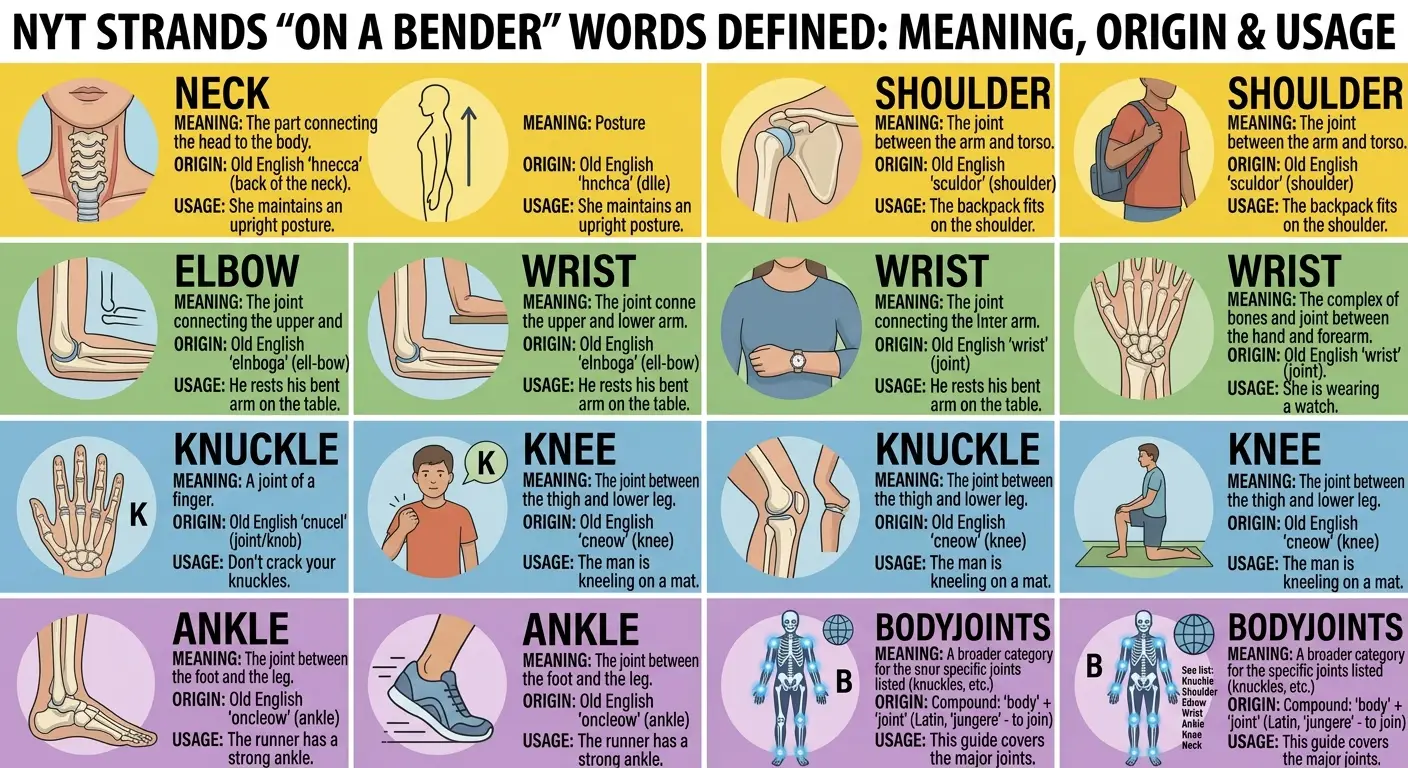
- Theme: "On a bender"
- Spangram: BODYJOINTS
- Theme Words: ANKLE, ELBOW, KNEE, KNUCKLE, NECK, SHOULDER, WRIST
- Connection: All are joints in the human body — parts that bend
The theme "On a bender" is a brilliant double meaning — while "on a bender" colloquially means on a wild drinking spree, here it literally refers to body parts that are benders — joints that allow bending and movement. Whether you solved the puzzle, got stuck on the spangram, or simply want to understand the words better, this vocabulary guide gives you clear, fascinating definitions with links to authoritative sources.
BODYJOINTS — Definition and Meaning (Spangram)
Body joints (written as BODYJOINTS in the spangram) are the anatomical structures where two or more bones meet, allowing movement, flexibility, and structural support throughout the human skeleton. A joint (also called an articulation) comes from Latin junctus ("joined"), from jungere ("to join, to yoke"). The human body contains approximately 360 joints, classified into three main types: synovial joints (freely movable, like the knee and elbow — the type referenced in today's puzzle), cartilaginous joints (slightly movable, like the spinal vertebrae), and fibrous joints (immovable, like skull sutures). Synovial joints contain synovial fluid — a lubricating liquid that reduces friction between cartilage surfaces. Joint diseases like arthritis (literally "joint inflammation") affect over 350 million people worldwide. The word "joint" also has many figurative meanings: a place of business ("burger joint"), a marijuana cigarette (slang), or "out of joint" (disordered or dislocated, as in Shakespeare's "The time is out of joint").
KNUCKLE — Definition and Meaning
A knuckle is the joint of a finger, especially the prominent rounded joint visible when the fist is clenched. The word derives from Middle English knokel, from Middle Low German knökel, diminutive of knoke ("bone") — literally "little bone." Each finger has three knuckles (the metacarpophalangeal, proximal interphalangeal, and distal interphalangeal joints), though "knuckle" typically refers to the large joints at the base of the fingers. Knuckles are condyloid joints that allow movement in two planes — bending/extending and side-to-side. The habit of "cracking knuckles" produces a popping sound from collapsing gas bubbles in the synovial fluid — research has shown it does not cause arthritis, contrary to popular belief. Idiomatic expressions include "knuckle down" (get to serious work), "knuckle under" (submit or yield), "white-knuckle" (terrifying — gripping so hard the knuckles turn white), and "brass knuckles" (a metal weapon worn over the fist). A "knuckleball" in baseball is a pitch thrown with minimal spin that moves unpredictably.
SHOULDER — Definition and Meaning
The shoulder is the joint connecting the arm to the torso — the most mobile and complex joint in the human body. The word derives from Old English sculdor, from Proto-Germanic *skuldrō. The shoulder joint (technically the glenohumeral joint) is a ball-and-socket joint where the humerus (upper arm bone) meets the scapula (shoulder blade). Its extraordinary range of motion — rotation, abduction, adduction, flexion, extension — makes it essential for throwing, lifting, and reaching, but also makes it prone to dislocation and rotator cuff injuries. The rotator cuff — a group of four muscles and tendons — stabilizes the joint. Beyond anatomy, "shoulder" is rich with figurative meaning: "shoulder the burden" (take responsibility), "cold shoulder" (deliberate snub), "shoulder to cry on" (emotional support), "rub shoulders with" (associate with), and the "shoulder" of a road is the paved edge alongside the main lane.
ELBOW — Definition and Meaning
The elbow is the joint connecting the upper arm to the forearm, allowing the arm to bend and straighten. The word comes from Old English elboga, combining ell ("forearm") + boga ("bow, bend") — literally "arm-bend." The elbow is a hinge joint formed where three bones meet: the humerus, radius, and ulna. The distinctive bump on the back of the elbow — the olecranon — is the tip of the ulna, and hitting it against the ulnar nerve produces the infamous "funny bone" tingling sensation (it's actually a nerve, not a bone — the name is a pun on "humerus/humorous"). "Tennis elbow" (lateral epicondylitis) is a painful overuse injury. Idiomatically, "elbow grease" means hard physical effort, "elbow room" means sufficient space, and "to elbow" someone means to push past them using your arm.
WRIST — Definition and Meaning
The wrist is the joint connecting the hand to the forearm, enabling the hand to flex, extend, and rotate. The word derives from Old English wrist, related to the verb wrīþan ("to twist, to writhe") — reflecting the wrist's twisting capability. The wrist (anatomically the carpus) is one of the most structurally complex joints in the body, consisting of eight small carpal bones arranged in two rows, connected by a network of ligaments. This intricate architecture allows the precise movements essential for writing, typing, tool use, and virtually every fine motor skill that distinguishes human dexterity. Carpal tunnel syndrome — compression of the median nerve at the wrist — is one of the most common occupational injuries, particularly among office workers and musicians. A "wristwatch" is a timepiece worn on the wrist (replacing pocket watches in the early 20th century), and a "wristband" can be a sweatband, bracelet, or event admission band. In sports, "wrist shot" (ice hockey) and "wrist spin" (cricket) describe techniques relying on wrist motion.
ANKLE — Definition and Meaning
The ankle is the joint connecting the foot to the leg, enabling walking, running, jumping, and balance. The word comes from Old English ancleow, from Proto-Germanic *ankulaz, possibly related to the Latin word angulus ("angle") — reflecting the angular shape of the joint. The ankle (technically the talocrural joint) is where the tibia and fibula (shin bones) meet the talus (foot bone). The bony bumps on either side of the ankle are the malleoli — the inner (medial) malleolus is part of the tibia, and the outer (lateral) malleolus is part of the fibula. Ankle sprains are the single most common sports injury worldwide, accounting for approximately 25,000 occurrences per day in the United States alone. An "ankle monitor" (or ankle bracelet) is an electronic tracking device used in law enforcement. "Ankle-biter" is slang for a small child or small dog.
KNEE — Definition and Meaning
The knee is the largest and most complex joint in the human body, connecting the thigh to the lower leg. The word comes from Old English cnēo, from Proto-Germanic *knewą, from Proto-Indo-European *ǵónu — the silent "k" in "knee" is a relic of the original pronunciation. The knee is a modified hinge joint where the femur (thighbone — the body's longest bone) meets the tibia, with the patella (kneecap) protecting the front. The knee contains crucial stabilizing structures: the ACL and PCL (cruciate ligaments) prevent forward-backward sliding, the menisci cushion impact, and the collateral ligaments prevent sideways movement. ACL tears are among the most feared injuries in sports. Idiomatically, "knee-jerk reaction" means an automatic, unthinking response (from the patellar reflex), "brought to their knees" means defeated or humbled, "on bended knee" means in a posture of supplication or proposal, and "the bee's knees" means something excellent (1920s slang).
NECK — Definition and Meaning
The neck is the body part connecting the head to the torso, containing the cervical spine — the joint system that allows the head to turn, tilt, nod, and rotate. The word comes from Old English hnecca ("back of the neck"), from Proto-Germanic *hnakkô. The neck's seven cervical vertebrae (the same number found in nearly all mammals, from mice to giraffes) form a series of joints that provide remarkable mobility while protecting the spinal cord, major blood vessels, the trachea (windpipe), and the esophagus. The atlas (C1 vertebra, named after the Titan Atlas who held up the sky) supports the skull, while the axis (C2) enables rotation. "Neck" generates an extraordinary number of English expressions: "neck and neck" (very close competition), "neck of the woods" (local area), "stick your neck out" (take a risk), "pain in the neck" (annoying person/thing), "rubbernecking" (staring at accidents), "bottleneck" (a point of congestion), and "redneck" (a working-class person, from sunburned necks of outdoor laborers). As a verb, "necking" is old-fashioned slang for kissing and embracing.
Why the Theme "On a Bender" = Body Joints
The theme "On a bender" works on two levels. In everyday slang, "on a bender" means going on a wild, extended drinking spree — but literally, a "bender" is something that bends. Every word in today's puzzle — ankle, elbow, knee, knuckle, neck, shoulder, wrist — names a body joint whose primary function is to bend. The spangram BODYJOINTS confirms the connection. This kind of clever wordplay — using a familiar phrase whose literal meaning reveals the hidden theme — is what makes NYT Strands one of the most satisfying daily word puzzles.
Summary of All Strands Words
Here's a quick-reference table for all words in today's NYT Strands puzzle:
| Word | Type | Short Definition | Common Idiom |
|---|---|---|---|
| BODYJOINTS ⭐ | Spangram | Where bones meet, allowing movement | "Out of joint" |
| KNUCKLE | Theme | Finger joint; bone prominence when fist is clenched | "Knuckle down" |
| SHOULDER | Theme | Joint connecting arm to torso; most mobile joint | "Cold shoulder" |
| ELBOW | Theme | Joint connecting upper arm to forearm | "Elbow grease" |
| WRIST | Theme | Joint connecting hand to forearm; 8 carpal bones | "Slap on the wrist" |
| ANKLE | Theme | Joint connecting foot to leg | "Ankle-biter" |
| KNEE | Theme | Largest joint in the body; connects thigh to shin | "Knee-jerk reaction" |
| NECK | Theme | Connects head to torso; 7 cervical vertebrae | "Neck and neck" |
Frequently Asked Questions
What is the NYT Strands spangram for August 17, 2026?
The spangram for today's NYT Strands puzzle (#897) is BODYJOINTS. It connects two opposite sides of the grid and reveals the theme — all the other words are joints in the human body.
What does "On a bender" mean in today's Strands?
The theme "On a bender" is a play on words. While "on a bender" usually means going on a drinking spree, here it literally refers to body parts that bend — the joints: ankle, elbow, knee, knuckle, neck, shoulder, and wrist.
What is the funny bone?
The "funny bone" is actually the ulnar nerve running behind the elbow. When struck against the olecranon bone, it produces a tingling, painful sensation. The name is a pun on the humerus bone.
What is the most complex joint in the body?
The knee is the largest and most complex joint, while the shoulder is the most mobile. The wrist is among the most structurally intricate with its eight carpal bones.
Why does cracking knuckles make a popping sound?
The popping sound from cracking knuckles is caused by gas bubbles collapsing in the synovial fluid within the joint. Research has shown this does not cause arthritis, despite the common myth.
What are the NYT Strands answers for August 17, 2026?
The answers for NYT Strands #897 (August 17, 2026) are: ANKLE, ELBOW, KNEE, KNUCKLE, NECK, SHOULDER, WRIST, with the spangram BODYJOINTS. The theme is "On a bender" — all words are body joints that bend.